+44 1865 259200
The challenge
Local authorities have a key role to play in helping to achieve challenging local and national targets for net zero. In part, this is about how councils operate as large organisations and service providers. This can include measures to improve council buildings’ energy efficiency, installing or sourcing low carbon energy, moving to a low carbon vehicle fleet and encouraging employees to adopt low carbon behaviours. Local authorities can also provide leadership to local partners, businesses and communities, giving information and support to carbon reduction initiatives and measures across the council area.
Through their local development plans, local authorities also have the opportunity to shape the type and location of development. Decisions taken now will have implications for many decades, so it is vital that policies avoid locking us into avoidable carbon emissions.
In delivering the spatial strategy set out in its adopted Local Plan, RBC has made a commitment to “be resilient to and mitigate climate change impacts especially by reducing and minimising the risks from flooding, reducing greenhouse gas emissions and improving water quality and efficiency”. This project aimed to provide the evidence base on which RBC can drive climate action through the introduction of stronger policies in a revised Local Plan.
The solution
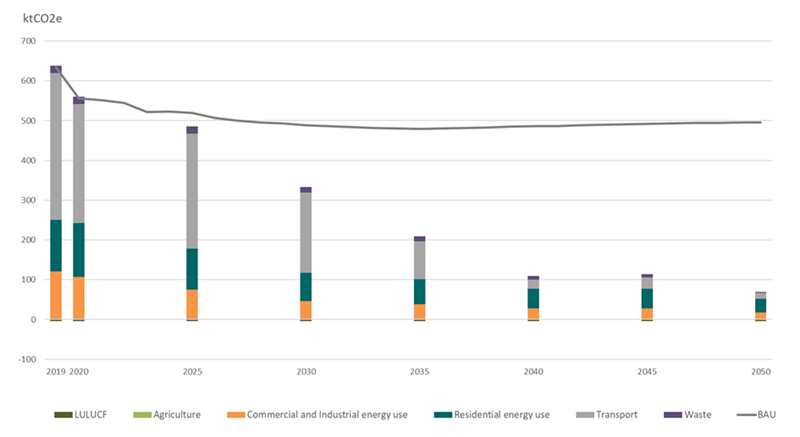
The first stage of the Study aimed to establish the Council’s baseline position in terms of Greenhouse Gas (GHG) emissions in order to further inform the Council’s priorities for action in its Climate Change Strategy. This helped the Authority understand its most significant sources of emissions, which can subsequently be used to prioritise actions to reduce emissions. This was delivered in Aether’s GHG baselining tool. Using the baseline emissions, the next step was to illustrate the ‘Business as Usual’ scenario, modelling future emissions assuming no further climate action is taken aside from decarbonisation of the electricity grid.
The second stage of the Study consisted of a series of options to provide evidence to underpin and support the introduction of stronger policies in the revised Local Plan. Aether led a sub-task to model an alternative ‘emissions reduction trajectory to 2050’ to illustrate the possible impacts of alternative, stronger actions, including societal changes on emissions in Runnymede borough. This trajectory demonstrated the scale of action/intervention required to reach net zero emissions in Runnymede and helps justify the introduction of stronger climate change planning policies.
The result
The Study has provided RBC with a rich evidence base to inform the development of draft planning policies to address both climate change mitigation and adaptation action through the delivery of sustainable development. Recommended policies include consideration of energy standards for domestic and non-domestic developments; sustainable design principles; renewable and low-carbon energy generation capacity and policy interventions; and climate change adaptation measures.
The emission reduction pathway and stakeholder engagement undertaken supports the assumption that emission reductions in Runnymede will most likely track UK national ambitions rather than aiming for significantly more ambitious earlier targets. If the Council wishes to consider an earlier target (or reduce its estimated residual emissions at 2050), then the pace of change will need to significantly increase, and it will require more local innovation to overcome technical challenges that may not have yet have mainstream solutions.
The full project documents and outputs can be found here.
Kirsten May
Principal Consultant
Related case studies
Railfreight Energy and Emissions Calculator (REEC)
Category: Cities and Local Authorities, Emission Inventories, Rail
REEC is the first tool for the UK that can calculate, to a high level of granularity and accuracy, the energy usage and resulting emissions for a specified freight train configuration travelling on specified routes on the GB rail network.
Read case studyLuton Council Net Zero Roadmap and Climate Policy and Action Plan
Category: Cities and Local Authorities
Aether, alongside SE2 and associate Joanne Wade, developed a Net Zero Roadmap and Climate Policy and Action Plan to support the council in its vision of a net zero town by 2040.
Read case studyRunnymede Borough Council Climate Change Study
Category: Cities and Local Authorities, Emission Inventories, Policies and Measures
Aether, in partnership with Land Use Consultants (LUC), delivered a package of works to support Runnymede Borough Council’s (RBC) review of the 2030 Local Plan with a view to introducing stronger policies to address the impacts of climate change.
Read case studyNews
Latest news
Posted on: 13 January 2026
Devolved Governments Air Pollutant Emissions Inventories
The air pollutant emissions inventories for England, Scotland, Wales, and Northern Ireland were published in September 2025. The data covers the period 2005 to 2023, for the pollutants ammonia, carbon monoxide, nitrogen oxides, non-methane volatile organic compounds, PM10, PM2.5, sulphur dioxide, and lead. In addition, experimental inventory statistics are presented for emissions of benzo[a]pyrene, dioxins and furans, and mercury.
Read full storyPosted on: 11 December 2025
Aether provided training to strengthen Government of Jersey’s climate policy modelling capacity
Aether completed a project for to train staff in Government of Jersey in using Aether's Carbon Scenario Model to quantify the carbon impacts of net zero policies. The model is a key tool for the Government of Jersey for informing policy decisions on climate actions, and other related policies.
Read full storyPosted on: 6 October 2025
Aether Experts Contribute to IPCC Report on Short-Lived Climate Forcers
In the first week of October Richard Claxton and Sergii Shmarin were in Istanbul, contributing as lead authors to the upcoming IPCC Methodology Report on Short-Lived Climate Forcers (SLCFs). SLCFs - such as black carbon, and other ozone precursors play a critical role in climate change and air quality. The new methodology report will provide essential guidance for countries to improve their emissions inventories and strengthen climate action.
Read full storyPosted on: 1 September 2025
Six new project wins for the land development services team
Aether has recently expanded its Land Development services and secured six new commissions with one of the UK’s top 14 house builders. These projects span from comprehensive Environmental Impact Assessments for large-scale residential developments to focused sustainability, energy, and air quality reports for smaller schemes.
Read full storyFilter news by category
Aether Blog Air Pollution Air Quality Assessments Barriers to Net Zero Capacity Building Carbon Footprint Climate Emergency Climate Equality Climate Finance Consumption COP28 Culture Data Visualisation Economic Status Emissions Reporting European Topic Centre GHG Infrastructure Inventories Local Government Mitigation MRV National Government Net Zero Oxfam Paris Agreement Policy Recruitment Society Stakeholder Engagement Waste Sector Wider Impacts
Testimonial